
CSV to CSA
"Assurance has replaced validation on paper, but our sites still run the old way." Changing how fifteen or twenty sites actually validate is the hard part. That is the work.
The problem in your words
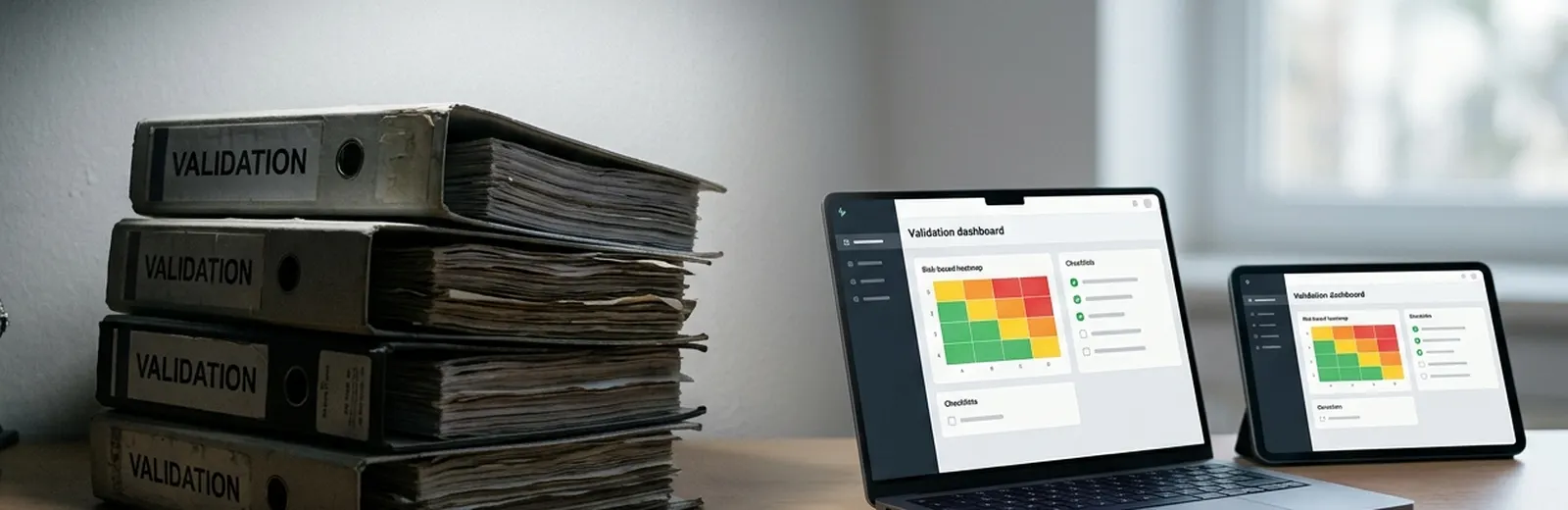
The FDA's Computer Software Assurance guidance is final, and GAMP 5 second edition moved the field from documentation volume to critical thinking. Your team has read it. Yet the templates still get filled the same way, the test scripts still run the same length, and the effort still spreads evenly across systems regardless of risk. Reading the guidance is not the same as changing the habit across an enterprise. The documentation instinct survives new guidance and new tooling alike; I wrote about that pattern in AI will not remove documentation from validation.
How I approach it
The DRIVE framework is the operating discipline that makes the shift real and keeps it inspection-ready: Documentation, Risk management, Implementation, Vendor assessment, Evidence management. Inside it sits a four-step CSA risk decision, applied at the function level rather than the system level: judge the impact on quality and safety, identify the implementation method, rate the risk one to five, then right-size the testing to match.
For multi-site estates, a Modular Qualification Architecture lets you qualify once and reuse, instead of repeating the same work at every site.
CSA is a return to validation's true intent, not a new methodology. Risk is judged at the function level. Critical thinking, documented, is the engine; the matrix is just the scaffold.
What you get
- A function-level risk framework your reviewers can apply consistently across sites.
- Right-sized templates and test approaches, scripted only where the risk earns it.
- A reviewer enablement programme, because the habit is the hard part (here's how I run the first 90 days).
- The transition rationale written into your Validation Master Plan, ready for the inspector who asks why.
From a comparable multi-site programme
Outcomes from a global pharmaceutical client, rewritten as an anonymised engagement. To estimate your own numbers, try the time-to-market calculator or the cost of poor quality calculator.
Related services
Questions leaders ask
What is Computer Software Assurance (CSA)?
Computer Software Assurance (CSA) is the FDA's risk-based approach to establishing confidence in computer systems, finalised in September 2025 and updated in February 2026 to align with the QMSR. It replaces documentation-heavy Computer System Validation (CSV) with documented critical thinking: rigorous scripted testing where a function affects patient safety or product quality, and lighter evidence, such as qualified vendor testing, everywhere else.
What is the difference between CSV and CSA?
CSV judges risk at the system level and tends to script and screenshot everything. CSA judges risk at the function level, so testing effort follows the specific risk: scripted testing for high-impact functions, unscripted or vendor evidence for the rest. The result is typically 25 to 50% less documentation on common system categories with equal or better inspection readiness.
Do existing validated systems have to move to CSA?
No. CSA applies to new projects immediately, and existing validated systems transition at their next revalidation or significant change. The transition rationale belongs in the Validation Master Plan, which is exactly what an inspector will ask to see.
Does the FDA CSA guidance apply to pharmaceutical manufacturers?
Not directly. FDA's CDRH and CBER issued it for device production and quality system software under 21 CFR 820, and CDER did not co-issue it. Pharma teams still use it, because GAMP 5 second edition applies the same critical thinking to GxP systems. Cite Part 11, Annex 11 and GAMP 5 as your basis, with CSA as supporting practice.
How far along is your CSA transition, really?
The CSA Maturity Check places you in six minutes and shows the first move.
Take the CSA Maturity Check Book a conversationWant a deeper first step? The Inspection-Readiness Review is a paid 90-minute senior session that pressure-tests your CSA position before an inspector does.