
I help pharma quality teams make their systems, and their AI, inspection-ready.
Senior-led validation, CSV to CSA transformation and AI governance for pharma, biotech and CDMO. 25 years of doing the work, and teaching teams to run it.
Sun Pharma’s team rated our CSV to CSA day 4.8 out of 5, from 60 participants.

Organisations I’ve worked with






Not sure where you stand? Take a free 6-minute check.
20 questions, one per screen. You see your tier and the gaps you can close yourself, on screen the moment you finish.
There are 4 ways to work with me
Most clients start with training or the book, and grow into the programme work. Start where your month is.
Validating AI in GxP, CSV to CSA, data integrity. On-site or online, up to CQO level.
Bring it in-house → AI validation & governanceRisk tiering, Annex 22 readiness, and an AI QMS your inspectors can follow.
Explore → QMS modernizationQMS 2.0, paperless validation and CSV delivery that holds up under scrutiny.
Explore → The bookValidating AI in GxP, the Company Edition, and the Practitioner Pack ready to run.
Get the tools →I'm building AIV Engine to run the method the same way every time
AIV takes one AI system, classifies it by risk, sizes the validation and builds the evidence set. The AI drafts, a person signs, and the record stands up in an inspection.
- 1Classify it.
- 2Size the validation to the risk.
- 3Build the evidence set.
- 4Record execution and release.
I walk the whole road with you
I do not write a report and say goodbye. I train the team, set up the quality system, implement, then stay close while it runs.
You have the AI tools. You have the use cases. But can you implement them?
The moment you put AI into a GxP process, the responsibility to validate it is yours. That is where I come in, and I stay for the whole road.
Walked before: an AI validation framework built in three months, nine AI projects live, FDA, MHRA and Russian health authority inspections cleared.
Start the AI journey →Reading the guidance did not change the habit. The journey does.
CSA becomes real when the team is trained, the quality system says the new rules out loud, and the first systems go through the new way.
Walked before: a global biopharma moved to a working CSA operating model in four months, with 23% less validation effort in the first quarter.
Start the CSA journey →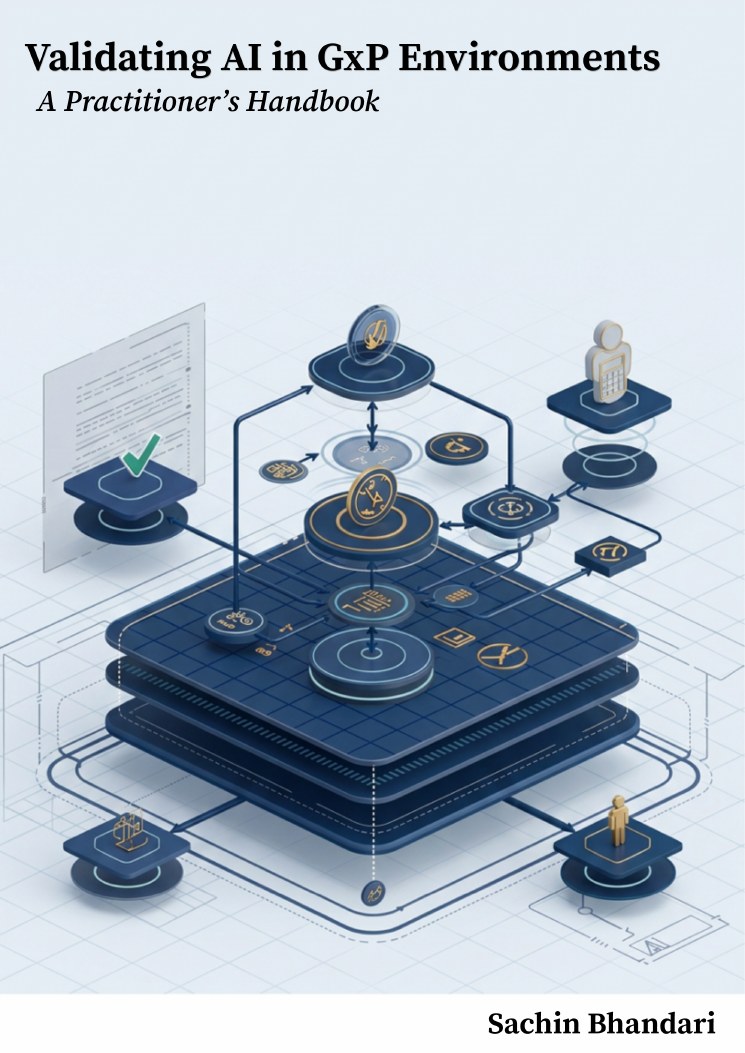
Validating AI in GxP: A Practitioner's Guide
The method, written down: the regulatory spine, how to classify and risk-tier AI use cases, how to build validation evidence that holds, and how to monitor a model after go-live. Written for quality, validation and IT leaders who already know CSV and need what comes next. Rated 4.7 out of 5 by its first readers.
Make AI, CSA or digital validation real in your organisation
Thirty minutes. You bring the pressure you are under; you leave with three concrete next moves. No fee, no deck, no juniors.
Book a conversationPrefer to check yourself first? Two free assessments: the AI Readiness Check and the CSA Maturity Check, six minutes each.
Prefer email? Write to info@trustbridge-compliance.com and you will get a reply within one working day.
Where CSV, CSA and AI in GxP get worked out
Read inside the quality and IT compliance functions of global pharma. Monthly, no filler.
Double opt-in. One-click unsubscribe on every email. No spam, ever.
Questions I get asked about validating AI in GxP
Who can help validate AI in a GxP environment?
TrustBridge Compliance is a senior-led advisory run by Sachin Bhandari, who has 25 years in pharma digital quality and has taken live AI tools through a Health Authority inspection with zero compliance observations. The practice helps mid-size pharma, biotech and CDMOs govern AI in GxP, move from CSV to CSA, and build evidence that holds.
How do you validate an AI model under GAMP 5?
Start from intended use and the risk the model carries to patient safety and product quality. Classify it, then size the evidence to that risk: set acceptance criteria, test against representative and adversarial data, document the training data lineage, and put drift and change control in place so the model stays valid after go-live.
What is the difference between CSV and CSA?
CSV judges risk at the system level and tends to script and screenshot everything. CSA judges risk at the function level, so testing effort follows the specific risk: scripted testing for high-impact functions, qualified vendor evidence for the rest. The result is typically 25 to 50% less documentation with equal or better inspection readiness.
Is my AI ready for an inspection under Annex 22?
Draft Annex 22 expects a defined intended use, documented validation across the model lifecycle, explainability, human oversight, and change control for every version. If you cannot show those on demand, you have a gap. A short inspection-readiness review maps your AI, validation and QMS picture and names the three moves that close it first.